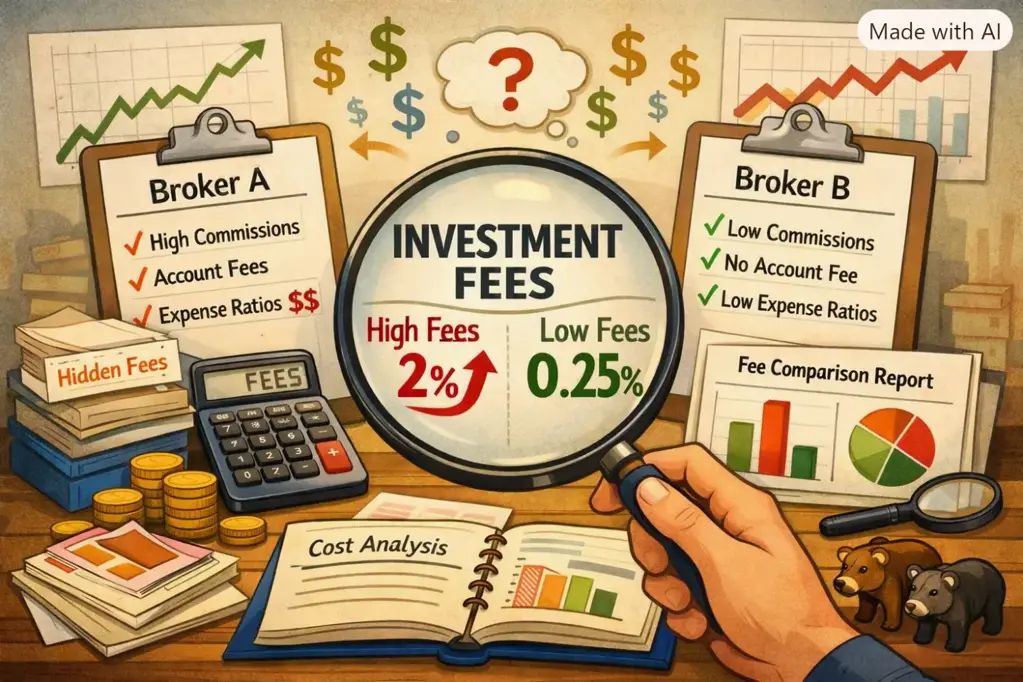
How to Compare Investment Fees Before Opening a Brokerage Account
Investment fees can look small on a price list, but they reduce your returns every year. A €3 trading charge or a 0.70% annual fund fee may not feel urgent when you are starting out. Over a decade or more, however, recurring costs can take a meaningful share of your investment growth.
Learning how to compare investment fees before opening an account helps you choose an arrangement that fits how often you invest, what you want to buy and how much support you need. The goal is not always to find the lowest advertised price. It is to understand the full cost of investing, including charges that may be easy to overlook.
Why Investment Fees Matter More Than Beginners Expect
Fees are paid from money that could otherwise stay invested and potentially grow. This makes them especially important for long-term investors. A one-off charge hurts once; an annual percentage fee can affect every future year because it also reduces the amount available to compound.
For example, assume you invest €10,000 for 20 years and earn 6% a year before fees. With a 0.20% annual cost, the investment could grow to about €30,680. With a 1.20% annual cost, it could grow to about €25,530. The 1% difference in annual fees costs roughly €5,150 in this simplified example.
Actual returns are never guaranteed, and taxes, inflation and market movements also matter. Still, costs are one of the few factors investors can review in advance. Lower beginner investing costs can leave more of your money working toward your goals.
The Main Types of Investing Fees to Check
Brokerage account fees vary by provider, account type, country and investment product. Read the provider’s official fee schedule and, for funds, the prospectus or key information document (KID). Focus on these common charges:
- Account or custody fee: A monthly or annual charge for holding an account or securities. It may be a flat euro amount or a percentage of your portfolio.
- Trading commission: A fee charged when you buy or sell shares, ETFs, bonds or funds. It can be fixed, percentage-based or both.
- Fund transaction fee: A dealing charge for buying certain mutual funds or ETFs, sometimes separate from the fund’s annual costs.
- Expense ratio or ongoing charge: The annual operating cost built into a fund’s performance. This is not normally billed as a separate invoice.
- Advisory or management fee: A percentage paid for a managed portfolio, robo-advice service or financial advice.
- Foreign exchange (FX) fee: A charge for converting euros into another currency to buy assets listed in pounds, dollars or other currencies.
- Transfer-out or account closure fee: A fee to move your holdings or cash to another broker.
- Inactivity, paper statement or corporate action fees: Less common charges that can still affect small accounts.
Also look for bid-ask spreads. The spread is the difference between the current buying and selling price of a security. It is not always listed as a broker fee, but it is a real transaction cost, particularly for less liquid shares and funds.
How to Compare Brokerage Account Fees Side by Side
Do not compare brokers using one headline such as “zero commission.” Instead, compare costs based on your likely behaviour. Someone investing €200 each month into one euro-denominated ETF needs a different price structure than someone making occasional share purchases in US dollars.
- Write down your expected activity. Estimate how much you will invest monthly, how many trades you may place each year, which markets you will use and whether you want a self-directed or managed account.
- Collect the official documents. Download each provider’s pricing page, full fee schedule and terms. Check the date, as prices can change.
- Calculate first-year euro costs. Add expected account fees, trade charges, FX charges and product costs. Include a realistic estimate rather than assuming ideal conditions.
- Check ongoing annual costs. Account maintenance, fund expense ratios and advisory fees can matter more than a one-time opening promotion.
- Review exit costs and service limits. Check transfer fees, minimum balances, fractional-share availability, tax documents, market access and customer support.
| Cost to compare | Question to ask | Where to find it |
|---|---|---|
| Account fee | Is there a monthly, annual or custody charge? | Broker fee schedule |
| Trade commission | What will each purchase and sale cost? | Trading price list |
| FX conversion | Will I pay to buy assets in another currency? | Currency conversion terms |
| Fund expense ratio | What percentage is deducted within the fund each year? | KID, prospectus or fund factsheet |
| Transfer-out fee | What does it cost to leave later? | Transfer and closure fee section |
A simple spreadsheet is enough for this exercise. You can also use a free budget app such as WhizBudget to set aside a regular investing amount and make sure fees fit comfortably within your wider financial plan.
How Expense Ratios Affect Fund Returns
Expense ratios explained simply: they are the annual costs of running an investment fund, expressed as a percentage of the money invested. They can cover administration, management, legal and operating expenses. The fee is generally reflected in the fund’s daily value, so you may not see a separate deduction in your brokerage account.
Suppose you invest €5,000 in two broadly similar funds. Fund A has a 0.15% expense ratio and Fund B has a 0.85% expense ratio. If both earn the same gross return, Fund A leaves more return in your account each year. On €5,000, the difference is €35 in the first year. As the investment and contributions grow, the euro difference can grow too.
Compare funds with similar objectives before focusing on cost alone. A global equity UCITS ETF, an actively managed European equity fund and a short-term bond fund do different jobs. Look at the benchmark, holdings, risk level, distribution policy and tracking approach alongside the ongoing charge.
How to Spot Hidden or Easy-to-Miss Charges
Hidden investing fees are not always deliberately concealed. Often, they are simply placed in detailed documents or only apply in certain situations. These are the charges beginners most often miss:
- Currency conversion mark-ups: A low or zero trade commission may be offset by an FX percentage each time you buy or sell a foreign-currency asset.
- Payment or withdrawal charges: Some platforms charge for card deposits, international bank transfers or particular withdrawal methods.
- ETF and fund spreads: Check whether a fund is thinly traded, as a wider spread raises the effective cost of entering and leaving.
- Securities lending arrangements: Some funds lend holdings to earn income. Review how revenue and risk are handled in the fund documents.
- Managed portfolio layers: A managed service may charge its own fee while the underlying funds also have expense ratios.
- Tax-related service fees: In some European countries, brokers charge for tax reporting, reclaiming withholding tax or issuing special statements.
Commission-free investing means the broker may not charge a stated commission on eligible trades. It does not mean the investment has no cost. Fund charges, spreads, FX fees and account fees can still apply. Always check which products qualify and whether there are minimum order sizes or other conditions.
A Simple Fee Comparison Checklist for New Investors
Use this checklist before submitting an account application:
- Read the complete brokerage account fees schedule, not only the marketing page.
- Estimate the annual cost based on your planned deposits and number of trades.
- Check the fund’s KID or prospectus for its ongoing charge and risks.
- Confirm whether your preferred investments trade in euros or require currency conversion.
- Look for custody, inactivity, withdrawal and transfer-out fees.
- Check whether advisory fees are charged in addition to underlying investment costs.
- Save copies of the fee documents and review them at least once a year.
If the information is unclear, ask the provider for written clarification before funding the account. A transparent provider should make its charges understandable.
Example: Comparing the Long-Term Cost of Two Investment Accounts
Imagine an investor contributes €250 a month for 15 years, or €45,000 in total. For illustration, assume investments return 6% a year before all fees.
| Account A | Account B | |
|---|---|---|
| Annual account fee | €0 | 0.30% of portfolio value |
| Monthly trade cost | €2 | €0 |
| Fund expense ratio | 0.20% | 0.70% |
| Estimated annual total cost | About 0.20% plus €24 trades | About 1.00% |
| Estimated value after 15 years | About €71,000 | About €67,000 |
These figures are rounded illustrations, not projections. Account A has trading costs, while Account B has free trades but higher recurring percentage fees. For a monthly investor, the lower ongoing cost could outweigh the fixed commissions over time. But the result could reverse for a person making many small trades or using different products. This is why a personalised comparison matters.
When a Higher Fee May Be Worth Paying
Cheapest is not automatically best. A higher fee may be reasonable when it provides value you will actually use, such as regulated advice, tax support relevant to your country, access to a needed investment, strong security features or a service that helps you stay disciplined.
For example, paying for advice could be useful if you have a complex cross-border tax position, an inheritance or major decisions around retirement. The key is to identify exactly what you receive, how the fee is calculated and whether less expensive options meet the same need. Avoid paying more simply because a price structure is difficult to understand.
WhizBudget can help you track your monthly cash flow before increasing investment contributions, so you can build a plan that leaves room for an emergency fund and essential expenses.
FAQs About Investment Fees for Beginners
Are commission-free trades really free?
No. Commission-free trades can remove a dealing commission, but you may still pay fund expense ratios, FX fees, spreads, account charges or other costs. Review the full fee schedule.
What is a good expense ratio for a beginner?
There is no single right number. Compare the expense ratio with funds that have the same investment objective, region, risk level and strategy. Broad index funds often have lower costs than specialist or actively managed funds, but suitability matters too.
Do I pay expense ratios separately?
Usually not. A fund’s ongoing charges are generally reflected in its net asset value and returns. You still pay them economically, even though they may not appear as a separate cash transaction.
Should I avoid brokers that charge an account fee?
Not necessarily. A broker with an account fee may still be cheaper overall if it offers low trading, FX or product costs that suit your plan. Calculate your expected total annual cost.
What fees matter most for monthly investors?
For regular investors, recurring fund costs, custody fees and per-trade charges often matter most. A fixed commission can be particularly expensive when each monthly contribution is small.
Can I transfer my investments if fees rise?
Often yes, but transfer rules and costs vary. Check whether in-specie transfers are available, whether cash transfers require selling investments and what transfer-out fees apply before opening the account.
Conclusion: Compare Costs Before You Commit
Before choosing a brokerage, compare the full picture: account charges, trading costs, FX fees, expense ratios, advisory charges, spreads and exit fees. Use realistic assumptions based on how you plan to invest, then revisit the numbers as your portfolio grows. A few minutes spent reviewing official documents can prevent expensive surprises later.
Start by putting your investing amount into a clear monthly plan. Use WhizBudget, the free budget app, to see what you can invest consistently, then use this fee checklist to compare accounts with confidence.

Joke of the day by GiggleTime