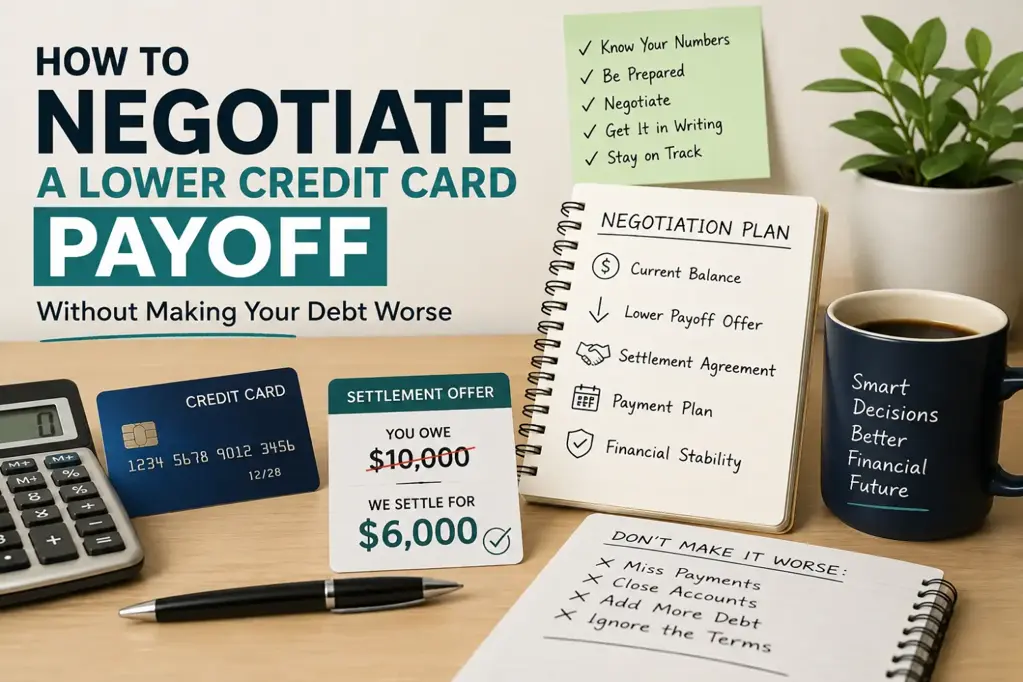
How to Negotiate a Lower Credit Card Payoff Without Making Your Debt Worse
If you are behind on credit card payments, or close to default, you may be wondering whether you can negotiate credit card payoff for less than the full balance. In some cases, a card issuer or debt collector may accept a reduced lump sum or structured settlement. But the process is risky if you rush, miss important details, or pay a company that promises results it cannot guarantee.
Credit card debt settlement can reduce what you owe, but it can also damage your credit file, trigger collection activity, and create a possible tax bill on forgiven debt. The goal is not simply to get a lower number. The goal is to settle credit card debt in a way that is clear, affordable, documented, and less harmful than doing nothing.
This guide explains when payoff negotiation makes sense, how to prepare, what to say, what to get in writing, and which warning signs to avoid. It is written for European readers dealing with credit card lenders, collection agencies, or debt purchasers, although exact rules vary by country. If you are unsure, consider speaking to a free debt advice charity, a regulated financial adviser, or a qualified tax professional.
When Negotiating a Credit Card Payoff Makes Sense
Negotiating a lower payoff usually makes sense only when the lender believes it may not recover the full balance. If your account is fully up to date and you have stable income, the issuer has little reason to accept less. If you are already behind, in serious financial hardship, or the account has been charged off or sold to a debt buyer, the lender may be more open to settlement.
You might consider trying to negotiate credit card debt if:
- You are 60 to 180 days behind on payments and cannot realistically catch up.
- You have received letters from a collections department or debt purchaser.
- You can raise a lump sum from savings, family help, sale of an asset, or a temporary income boost.
- Your budget shows that minimum payments are no longer sustainable.
- You want to avoid a court claim, enforcement action, or years of unaffordable payments.
Settlement is not ideal if you can still afford contractual payments or if a short-term credit card hardship program would solve the problem. It is also not a good strategy if you would need to borrow from another high-interest lender to fund the settlement. Replacing one unaffordable debt with another can make your situation worse.
Payoff Negotiation vs. Hardship Program vs. Debt Management Plan
Before you settle credit card debt, understand the main options. A lower payoff is only one route. Depending on your income, credit file, and local consumer debt rules, another option may be safer.
| Option | How it works | Best for | Main risk |
|---|---|---|---|
| Payoff negotiation | You ask the issuer or collector to accept less than the full balance, usually as a lump sum or short instalment plan. | People already behind who can access a settlement amount. | Credit damage, tax issues, and risk of paying without proper written agreement. |
| Credit card hardship program | The lender may reduce interest, pause fees, or lower payments for a limited period. | People with temporary hardship who may recover soon. | The account may be restricted or closed, and arrears may still affect your credit file. |
| Debt management plan | You make one affordable monthly payment, often through a nonprofit or regulated provider, which is distributed to creditors. | People with multiple unsecured debts and limited spare income. | Creditors may not freeze interest, and repayment can take several years. |
A hardship plan is often worth asking about before settlement if your income drop is temporary. A debt management plan can help if you owe several lenders and cannot negotiate each one alone. A settlement may be better if the account is already seriously delinquent and you have a realistic one-off amount to offer.
What to Do Before Contacting Your Credit Card Issuer
Preparation is the difference between a controlled negotiation and a stressful phone call that leads to a bad deal. Do these steps before you contact the issuer, collector, or debt buyer.
- List all debts. Include balances, account numbers, current status, interest rates, arrears, and who owns or collects each debt.
- Build a survival budget. Prioritise rent or mortgage, utilities, food, transport, insurance, child costs, and taxes before unsecured debt.
- Check what you can genuinely afford. Do not offer money needed for essentials. A settlement you cannot pay is not a settlement.
- Review your credit file. Check whether the account is marked as late, defaulted, charged off, or sold. This helps you understand who has authority to settle.
- Confirm the debt owner. If a collection agency contacts you, ask whether it owns the debt or collects on behalf of the issuer.
- Save a settlement fund separately. Keep it away from your daily spending account so you know exactly what you can offer.
- Decide your opening offer and maximum offer. Never negotiate without a ceiling.
A budgeting tool such as WhizBudget can help you separate essential spending from debt payments, estimate a realistic offer, and avoid agreeing to a settlement that leaves you short on rent or bills.
How Much Credit Card Companies May Agree to Settle For
There is no guaranteed settlement percentage. Be cautious of anyone who promises that all credit card companies will accept a specific amount. Outcomes depend on the lender, country, age of the debt, your hardship, whether the debt has been sold, and how much the collector believes it can recover through normal collection.
In general, creditors are more likely to consider a lower payoff when the account is seriously overdue, when the borrower can show real hardship, and when the offer is paid quickly. Debt purchasers that bought old accounts for less than face value may sometimes be more flexible, but they may also pursue collection aggressively.
Factors that can affect your settlement offer include:
- How many months you are behind.
- Whether interest and fees are still being added.
- Whether the account has been defaulted or sold.
- Your income, assets, and hardship evidence.
- Whether you offer a lump sum or instalments.
- Local rules on limitation periods, court claims, and debt enforcement.
As a practical approach, start lower than your maximum but not so low that the creditor refuses to engage. If you can pay €2,000 on a €6,000 balance, you might open below that and leave room to move. But do not invent numbers or pretend to have no income if that is not true. Creditor notes, call recordings, and affordability checks may be used later.
Step-by-Step: How to Negotiate a Lower Payoff
Use a calm, organised process. The goal is to reduce confusion and protect yourself before any money leaves your account.
- Call the correct department. Ask for the hardship, recoveries, settlements, or collections team. Front-line customer service may not have authority.
- Explain the hardship briefly. Mention job loss, illness, reduced hours, relationship breakdown, cost-of-living pressure, or other genuine cause. Keep it factual.
- State that you cannot afford the full balance. Avoid long emotional arguments. The key is affordability.
- Ask whether settlement is available. Do not begin by offering your maximum amount.
- Make a controlled opening offer. If you have a lump sum, say it is available only if the agreement is confirmed in writing.
- Ask about account reporting. Clarify whether it will be marked as partially settled, settled, satisfied, or similar wording used in your country.
- Request a written agreement before paying. This is non-negotiable. Never rely on a phone promise.
- Pay only through a traceable method. Use bank transfer, card payment, or another method that creates a record. Avoid cash or informal transfers.
- Keep every document. Save letters, emails, payment confirmations, account statements, and call notes.
- Check final reporting. After payment, verify that the balance is updated to zero or the agreed status on your statement and credit file.
If you speak by phone, write down the date, time, name of the representative, department, phone number, and summary of what was said. After the call, send a short follow-up email or letter confirming your understanding.
What to Say on the Phone or in Writing
You do not need to sound like a lawyer. You need to be clear, honest, and firm. Below is sample phone language you can adapt.
Sample phone script:
"I am calling about my credit card account. My financial situation has changed and I cannot afford the full balance or the normal monthly payments. I have reviewed my budget and can offer a one-off payment of [amount] as full and final settlement, if you confirm in writing that this will resolve the account and that no further balance will be pursued. Is this something your settlements team can consider?"
If the representative refuses, ask:
"Can you tell me what options are available for someone in financial hardship? Is there a credit card hardship program, interest freeze, payment plan, or settlement review process?"
If the creditor makes a counteroffer that is too high, respond with:
"I understand. Unfortunately, that amount is not affordable based on my current income and essential costs. My maximum available amount is [amount]. I do not want to agree to a payment I cannot make. Can this be reviewed again?"
You can also send a debt settlement letter. Keep it concise and include the account number, your hardship, the proposed amount, payment deadline, and request for written confirmation.
Sample debt settlement letter:
Dear [Creditor/Collector],
I am writing about account number [number]. Due to [brief reason], I am unable to pay the full outstanding balance. After reviewing my income and essential expenses, I can offer [amount] as a full and final settlement of this account.
This offer is made on the condition that, if accepted and paid by [date], the payment will satisfy the account, the remaining balance will not be sold or pursued, and the credit file will be updated to show the agreed settlement status. Please confirm the agreement in writing before I make payment.
Yours faithfully,
[Name]
Do not include unnecessary personal details. Do not send bank statements or medical documents unless you are comfortable and they are genuinely needed. Redact sensitive information where appropriate.
Documents and Terms You Must Get in Writing
Never pay a settlement based only on a phone conversation. A proper written agreement protects you if the account is later passed to another collector or the remaining balance is mistakenly pursued.
Before paying, confirm these terms in writing:
- Your full name and account number.
- Name of the creditor, collection agency, or debt owner.
- The current outstanding balance.
- The exact settlement amount.
- Whether the payment is a full and final settlement or partial settlement.
- The deadline for payment.
- Where and how to pay.
- Confirmation that no further amount will be collected after the agreed payment.
- Confirmation that the remaining balance will not be sold to another collector.
- How the account will be reported to credit reference agencies.
- Whether interest, fees, and collection activity will stop after payment.
- The name, job title, and contact details of the person or department issuing the agreement.
If the letter says only that your payment will be credited to the account, that is not enough. It must clearly say what happens to the unpaid balance. If the wording is unclear, ask for it to be amended before you pay.
Risks to Understand Before Settling Credit Card Debt
Settlement can be useful, but it is not painless. Understand these risks before you negotiate credit card payoff.
- Credit score damage: Missed payments, defaults, and partial settlements can remain on your credit file for years, depending on local reporting rules.
- Collection pressure: If negotiations fail, the creditor may continue calls, letters, or legal action.
- No guaranteed approval: The issuer can refuse your offer or ask for more than you can afford.
- Tax consequences: In some countries, forgiven debt may be treated as taxable income or have reporting consequences.
- Scam risk: Some debt settlement companies charge high fees and tell consumers to stop paying without explaining the damage.
- Account closure: Settled accounts are usually closed and cannot be used again.
The biggest mistake is stopping payments deliberately just to force a settlement when you could afford them. That can create avoidable late fees, default markers, stress, and legal risk.
Tax, Credit Score, and Collection Account Considerations
Tax treatment varies across Europe. In some places, cancelled or forgiven consumer debt may create taxable income. In others, personal insolvency or formal debt solutions may have different rules. Before accepting a large write-off, check local tax guidance or speak to a qualified adviser.
Credit file wording also matters. A settlement may be reported as settled, partially settled, satisfied, default satisfied, or a similar status. A partial settlement tells future lenders that you did not repay the full amount. That may affect mortgage applications, car finance, rental checks, or future credit card approval.
If a debt is already with a collection agency, identify whether the agency owns the account. If it only collects on behalf of the original issuer, the agreement should clearly show that the creditor authorised the settlement. If the debt has been sold, ask for evidence that the buyer has the right to collect and settle the account.
Also be aware of limitation periods. In many European jurisdictions, old debts may become legally unenforceable after a certain period if no payment or written acknowledgement has been made. The rules are specific and can be complex. Making a small payment or admitting liability may restart the clock in some places. Get advice before negotiating very old debts.
Red Flags: When Not to Use a Debt Settlement Company
Some people prefer professional help, especially if they have several creditors. But debt settlement companies can be expensive, and some operate in ways that harm consumers. Be very careful before paying anyone to negotiate credit card debt for you.
Red flags include:
- They guarantee a specific settlement percentage.
- They tell you to stop paying creditors without explaining consequences.
- They charge large upfront fees before any debt is settled.
- They refuse to explain their regulatory status or complaints process.
- They tell you not to speak to your creditors.
- They promise to remove accurate negative information from your credit file.
- They pressure you to sign immediately.
- They do not provide a clear written fee schedule.
Free or low-cost debt advice charities, consumer organisations, and regulated nonprofit agencies may be safer starting points. If you choose a paid company, check whether it is authorised in your country and whether its fees are reasonable compared with the possible savings.
Alternatives If the Issuer Refuses to Settle
If the card issuer refuses your settlement offer, do not panic. You may still have options.
- Ask for a credit card hardship program: Request reduced interest, fee waivers, a payment holiday, or lower monthly payments.
- Offer a short repayment plan: If you cannot pay a lump sum, ask whether they will accept instalments over three to twelve months.
- Use a debt management plan: A structured plan can help with multiple unsecured debts.
- Prioritise essential bills: Do not pay credit cards before housing, food, utilities, taxes, or child maintenance.
- Sell non-essential assets: Only if it does not harm your ability to work or live safely.
- Seek formal debt advice: Depending on your country, insolvency, debt relief, or court-approved repayment options may be available.
- Improve cash flow: Cut unused subscriptions, negotiate bills, switch providers, or add temporary income.
Use WhizBudget to test different repayment scenarios before accepting any plan. If a proposed payment leaves your monthly budget negative, it is not sustainable, even if the creditor agrees to it.
FAQs
Can I negotiate credit card payoff myself?
Yes. Many people negotiate directly with their card issuer, collector, or debt buyer. The key is to prepare a budget, know your maximum offer, speak to the right department, and get the agreement in writing before paying.
Will credit card debt settlement ruin my credit score?
It can seriously damage your credit file, especially if the account already has missed payments or a default. A partial settlement may stay visible for years, depending on your country. However, if you are already in default, settling may help stop the balance from growing and close the account.
Is a credit card hardship program better than settlement?
It may be better if your hardship is temporary and you can afford reduced payments. A hardship program may lower interest or pause fees without requiring a lump sum. Settlement is usually more suitable when you cannot repay the full balance and the account is already seriously overdue.
Should I send a debt settlement letter or call first?
You can do either. A call may help you find the correct department and learn what options exist. A debt settlement letter creates a written record. Even if you negotiate by phone, insist on written confirmation before making any payment.
Can a creditor chase me after I pay a settlement?
If the agreement was poorly written, errors can happen. That is why your settlement letter must state that the agreed payment resolves the account and that the remaining balance will not be pursued or sold. Keep proof of payment forever.
Do I pay tax on forgiven credit card debt?
Possibly. Tax rules differ by country and by the type of debt solution used. A large forgiven balance may have tax consequences. Check local tax guidance or speak to a qualified tax adviser before agreeing to a major write-off.
Conclusion
Negotiating a lower credit card payoff can be a practical way to deal with unaffordable debt, but only if you protect yourself. Do not rely on verbal promises, do not offer money you need for essentials, and do not trust companies that guarantee results. Prepare your budget, confirm who owns the debt, make a realistic offer, and get every important term in writing.
If settlement is not suitable, ask about a credit card hardship program, debt management plan, or free debt advice. The best option is the one you can actually afford without falling behind on rent, food, utilities, or taxes.
WhizBudget can help you see your real monthly numbers, plan a safe settlement fund, and compare repayment options before you contact creditors. Start by building a clear budget today, then negotiate from a position of control rather than panic.
More From the Blog



Joke of the day by GiggleTime