How to Save Money on a Variable Income When Your Paychecks Change Every Month
When your income changes from one month to the next, saving can feel impossible. A freelancer may have one excellent client payment followed by a quiet month. Contractors can face gaps between projects, while commission-based and seasonal workers may earn most of their money in only part of the year.
The answer is not to wait for a perfect month or to use the same budget designed for a fixed salary. Learning how to save money on a variable income means building a plan around your lowest realistic earnings, then deciding in advance where extra income goes. This approach gives every payment a job without assuming that next month will look the same.
Why Saving Is Hard When Your Income Changes
With a fixed salary, it is easy to schedule bills and savings around a predictable payday. With irregular earnings, a large payment can create a false sense of security. It is tempting to spend as though that amount will arrive every month, only to feel squeezed when work slows down.
The real challenge is cash-flow timing. You may earn enough across a year but still struggle in individual months because invoices are paid late, commissions vary, or your busy season is short. Saving with irregular income works best when you separate three questions:
- What must I pay each month to keep life running?
- How much of this payment belongs to tax and near-term obligations?
- What percentage can I put toward future goals before increasing discretionary spending?
That structure turns an unpredictable income into a series of manageable decisions.
Calculate Your Minimum Monthly Income and Core Expenses
Start with a conservative income baseline. This is not your average month and not your best month. It is the lowest amount you can reasonably expect to receive in a normal working month, based on the past 12 months if possible. If your work is new, use your lowest recent reliable month and revise it as you collect more data.
Next, list your core monthly expenses: housing, utilities, basic food, transport, insurance, debt minimums, childcare, phone and essential subscriptions. Include annual or quarterly bills by dividing them into monthly amounts. For example, a €360 annual insurance bill equals €30 per month.
| Monthly core expense | Example amount |
|---|---|
| Rent or mortgage | €850 |
| Utilities and phone | €180 |
| Food and household basics | €320 |
| Transport and insurance | €190 |
| Debt minimums and essential subscriptions | €110 |
| Total core expenses | €1,650 |
Compare this total with your conservative income baseline. If your baseline is €2,000 and core costs are €1,650, you have €350 of planned room. If core costs exceed your baseline, reduce flexible costs, review fixed bills, or seek ways to stabilise income before setting ambitious savings goals. A variable-income budget must survive an ordinary slow month.
Create a Variable-Income Spending Baseline
Your spending baseline is the amount you allow yourself to use in a lean month. It includes core expenses plus a realistic, limited amount for flexible spending such as coffee, social plans, clothing and hobbies. Think of it as your “normal month” lifestyle, not a punishment budget.
Set this baseline from your conservative income, rather than from whatever lands in your account. For instance, if your minimum monthly income is €2,000, you might allocate €1,650 to core costs, €150 to flexible spending and €200 to planned saving or future expenses. Any income above €2,000 is then handled by rules, not impulse.
This is the key difference between a standard budget and a variable income budget: expenses are anchored to the floor of your income, while higher earnings are allocated separately. Review your baseline every three to six months, especially after rent changes, a new contract or major lifestyle changes.
Use a Separate Buffer Account for High-Income Months
A cash-flow buffer account holds money that smooths the gap between high-income and low-income months. It is different from money set aside for a specific goal: its purpose is to help you pay yourself your baseline amount when client work is quiet or payments arrive later than expected.
Keep this account separate from your daily spending account so a strong month does not look like spendable cash. After a large payment arrives, move the portion intended to cover future baseline months into the buffer. Then transfer a set amount from the buffer to your current account each month, as if you were paying yourself a salary.
- Choose a target, such as one to three months of your spending baseline.
- In high-income months, direct a fixed share of surplus income to the buffer.
- In low-income months, use the buffer only to bring available cash up to your baseline.
- Refill it after the next strong payment instead of treating it as extra spending money.
This makes cash flow easier to read and reduces the urge to make dramatic spending changes every time a payment is late.
Set a Percentage-Based Savings Rule
Fixed euro amounts can be difficult when income fluctuates. A percentage rule scales with what you earn, so you continue the habit in both modest and strong months. Choose percentages that fit your actual situation and apply them to every payment after reserving tax where required.
A practical starting point might be 10% for short-term goals and 5% for long-term savings or investing. If your margins are tight, begin with 2% to 5%. The percentage matters less than using a rule you can maintain. When income rises, your savings rise automatically without requiring a new decision.
You can use separate percentages for different priorities:
- Cash-flow buffer: 10% to 20% of surplus income until your target is reached.
- Short-term goals: 5% to 15% for planned purchases, travel or annual bills.
- Long-term savings: 5% to 15%, subject to your goals, risk tolerance and local investment options.
Track these allocations in a free budget app such as WhizBudget. Seeing each category separately helps you avoid confusing money for next month’s bills with money available for a goal.
Prioritise Savings When a Large Payment Arrives
Large payments need a clear order of priority. Do not wait until the end of the month to see what remains; by then, the surplus may have disappeared into unplanned spending. Divide the payment as soon as it clears.
Here is a worked example for a freelancer who receives €5,000 in a strong month. Their usual monthly baseline is €2,000, and they need to reserve money for taxes based on their local rules. The example uses a 25% tax allocation for illustration only; your rate may be very different.
| Allocation | Amount | Purpose |
|---|---|---|
| Taxes (25%) | €1,250 | Held separately for tax payments |
| Essential expenses | €1,650 | Core costs for the current month |
| Flexible spending | €150 | Within the monthly baseline |
| Cash-flow buffer | €900 | Supports future low-income months |
| Short-term goal savings | €600 | Annual costs, planned purchase or travel |
| Long-term savings | €450 | Long-range financial goals |
| Total | €5,000 |
The exact split will vary, but the sequence is useful: reserve tax, fund this month’s baseline, strengthen future cash flow, then fund goals. Any remaining amount can be allocated deliberately rather than absorbed by lifestyle inflation.
Plan for Taxes, Slow Seasons and Income Gaps
For self-employed workers, tax money is not available income. Keep it in a separate account from the day you are paid. Tax systems differ across Europe, and VAT, social contributions, income tax instalments and deductible expenses can all affect what you should reserve. Use recent returns, an accountant or your tax authority’s guidance to estimate your percentage.
Also map your seasonal pattern. Review the last year and mark months when work or sales typically slow down. If you earn most of your income from May to September, your cash-flow plan should intentionally fund the autumn and winter months. This is cash flow planning for freelancers and seasonal workers: match money received in busy periods to expenses due throughout the year.
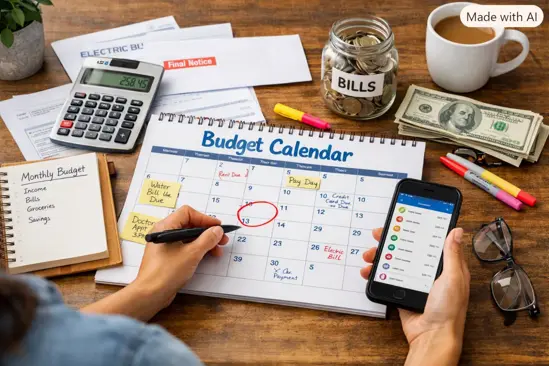
Create a simple calendar for irregular costs too, including professional memberships, software renewals, vehicle costs, holiday travel and tax deadlines. A predictable annual bill should not become a financial surprise simply because it is not monthly.
Adjust Your Savings Target Without Abandoning the Habit
Some months will be genuinely lean. When that happens, reduce your savings percentage if necessary, but avoid stopping the system entirely unless essential costs require it. A small contribution keeps your process active and makes it easier to increase again when work improves.
For example, if your usual long-term savings rate is 10%, you might lower it to 3% during a slow month, then return to 10% or add a little more after the next major invoice. This is how to save when income fluctuates without relying on all-or-nothing thinking.
Use a monthly review to compare income received, baseline spending, tax set-asides and buffer balance. WhizBudget can make this easier by showing whether your spending stayed within the baseline and whether each payment was allocated according to your rule.
Common Mistakes People Make With Irregular Income
- Budgeting from the best month: This leads to commitments that cannot be supported when work is quieter.
- Spending before reserving tax: Tax bills can disrupt otherwise healthy finances.
- Keeping all money in one account: It becomes too easy to spend funds intended for future months or goals.
- Using averages without checking timing: Annual income may look fine while monthly cash flow remains difficult.
- Increasing lifestyle costs after one strong payment: Recurring upgrades can create pressure long after the large payment is gone.
- Giving up after a low-income month: Adjusting the percentage is more effective than abandoning your saving routine.
Frequently Asked Questions
How much should I save with an irregular income?
Start with a percentage you can sustain, such as 5% to 10% of income after tax set-asides. If money is tight, even 2% to 5% builds the habit. Increase the rate in stronger months rather than committing to a fixed amount you cannot meet consistently.
Should I budget using my average income or my lowest income?
Use a conservative, reliable income figure to set your core spending baseline. An average can help with annual planning, but it may hide low months. Build regular spending around a lower figure and allocate income above it using clear rules.
What is a cash-flow buffer account?
It is a separate account used to smooth uneven pay. You add money during high-income months and use it to cover your normal spending baseline during slower months or delayed payment periods.
How do freelancers save for taxes?
Reserve a percentage from every client payment in a separate tax account. The appropriate percentage depends on your country, income, deductible expenses, VAT position and social contributions, so check official guidance or consult a qualified tax professional.
What should I do after receiving a large client payment?
Allocate it immediately: first reserve tax, then cover core expenses, add to your cash-flow buffer, and fund short-term and long-term savings goals. This prevents a one-off payment from turning into unplanned spending.
Can I save money in a low-income month?
Yes, but the amount may be small. Lower your savings percentage temporarily while protecting essential spending. The goal is to maintain a flexible system, not to force an unrealistic contribution.
Build a Saving System That Works in Every Season
Variable earnings do not prevent you from saving; they simply require a different structure. Set spending from a conservative income baseline, separate future-month cash from daily spending, reserve tax early and use percentages to allocate every payment. Over time, strong months will support quiet ones instead of disappearing without a plan.
Ready to see where each payment should go? Use WhizBudget, the free budget app, to track your baseline, savings goals and cash-flow buffer in one clear place. Start with your next payment and give every euro a purpose.