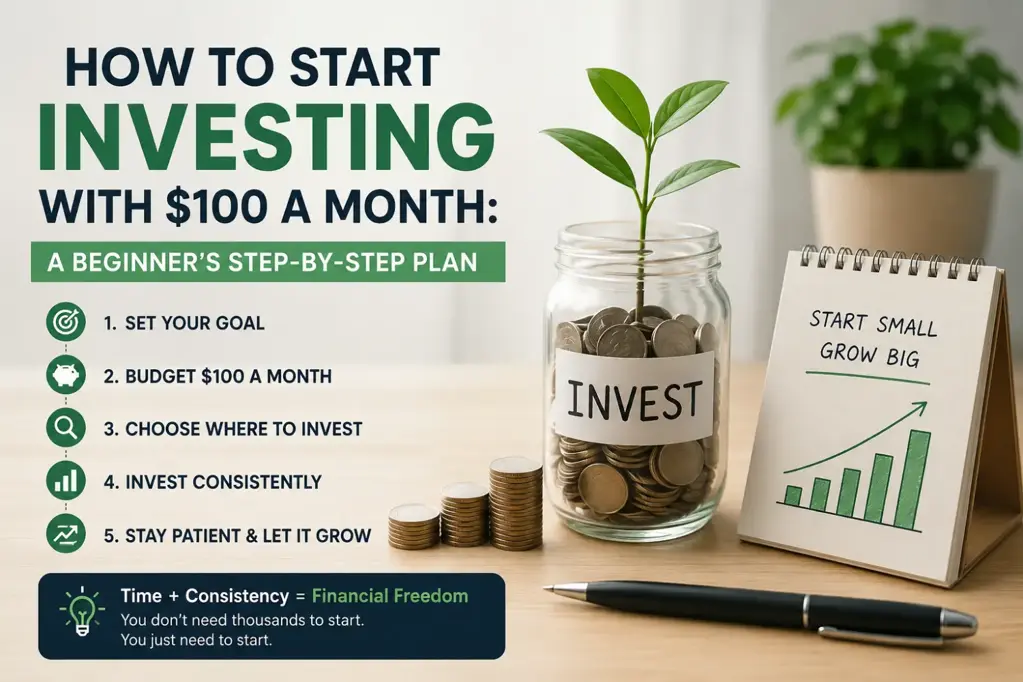
How to Start Investing With $100 a Month: A Beginner’s Step-by-Step Plan
If you have ever thought, I would invest if I had more money, you are not alone. Many beginners across Europe assume investing is only for people with large salaries, property, or thousands of euros sitting in the bank. The good news is that you can start investing with $100 a month, or roughly a similar amount in euros, and build a serious habit over time.
This guide is designed for people who are new to investing, want practical steps, and do not want complicated jargon. You will learn how to check your financial basics, choose an investment account, pick beginner-friendly investments, automate your contributions, and avoid common mistakes. We will also look at what $100 a month could become over the long term, using realistic assumptions rather than guaranteed promises.
Investing with little money is not about getting rich quickly. It is about building consistency, giving your money time to grow, and learning how markets work while the stakes are manageable.
Why $100 a Month Is Enough to Start Investing
$100 a month may not sound like much, especially when housing, energy, food, and transport costs are high. But investing is not only about the amount you start with. It is also about time, consistency, and the power of compounding.
Compounding means your investments can earn returns, and then those returns may earn returns in the future. Over years and decades, this can make small monthly contributions more powerful than they first appear.
Starting with $100 a month can help you:
- Build the habit of paying your future self first.
- Learn how investing works without risking large sums.
- Benefit from long-term market growth.
- Avoid waiting for the perfect moment, which often never comes.
- Create a monthly investing plan that can grow with your income.
For many beginners, the biggest obstacle is not money. It is confidence. Once you understand the basics and start small, investing becomes less intimidating.
Step 1: Make Sure Your Financial Basics Are Covered First
Before you invest, make sure your financial foundation is stable. Investing involves risk, and the value of your investments can go down as well as up. You do not want to sell investments at a bad time because you need cash for rent, an emergency bill, or credit card payments.
Start with these basics:
- Track your income and spending. Know exactly how much comes in and where it goes each month.
- Build a small emergency fund. Aim for at least one month of essential expenses first, then work toward three to six months over time.
- Deal with expensive debt. If you have high-interest credit card debt or payday loans, paying them down should usually come before investing.
- Cover your essentials. Rent or mortgage, bills, food, insurance, transport, and minimum debt payments should be secure before you invest.
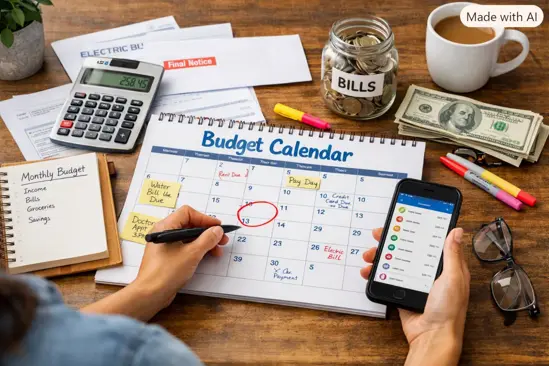
A simple budgeting tool can make this step much easier. WhizBudget can help you see whether $100 a month is realistic, where you can reduce spending, and how to create a dedicated investing category in your budget.
If $100 feels too much right now, start with $25 or $50. The habit matters. You can increase later when your finances improve.
Step 2: Choose the Right Investment Account
To start investing for beginners, the first practical step is choosing where your investments will live. The best account depends on your country, tax rules, goals, and time horizon. In Europe, account types vary, but the basic idea is usually similar: you open an account with a bank, investment platform, pension provider, or broker.
Here are common options to consider:
| Account type | Best for | Beginner notes |
|---|---|---|
| General investment account | Flexible investing with no specific tax wrapper | Easy to open, but taxes may apply to dividends, capital gains, or both depending on your country. |
| Tax-efficient investment account | Long-term investing with potential tax benefits | Examples include ISAs in the UK or country-specific investment savings accounts. Rules differ across Europe. |
| Pension account | Retirement investing | May offer tax advantages, but access is usually restricted until later life. |
| Robo-adviser account | Hands-off investing | You answer questions and the platform builds a portfolio for you, usually for an extra fee. |
| Employer pension scheme | Workplace retirement saving | If your employer matches contributions, this can be one of the best investments for beginners. |
When comparing platforms, pay close attention to fees. With a small monthly amount, high fixed fees can eat into your returns. Look for:
- Low or no monthly account fees.
- Low trading fees, especially if you invest monthly.
- Access to low-cost index funds or ETFs.
- Automatic investing options.
- Clear tax documents and local regulatory protection.
Always choose a regulated provider in your country or region. For example, look for oversight by a recognised financial authority, such as the FCA in the UK, BaFin in Germany, AMF in France, or your local regulator.
Step 3: Pick Beginner-Friendly Investments
Once your account is open, you need to decide what to invest in. This is where many beginners get overwhelmed. The financial world is full of individual shares, bonds, funds, crypto assets, commodities, and complex products. You do not need most of them when you are starting out.
For beginners investing with little money, broad, low-cost funds are often a sensible place to begin. Two common choices are index funds and ETFs.
What is an index fund?
An index fund is a fund that tries to track a market index. For example, a global stock market index fund may hold shares in thousands of companies across different countries and sectors. Instead of trying to pick the next winning company, you buy a small piece of the wider market.
What is an ETF?
An ETF, or exchange-traded fund, is similar to a fund but trades on an exchange like a share. Many ETFs track indexes. They are popular because they are widely available, transparent, and often low-cost.
Beginner-friendly investment options may include:
- Global equity index funds or ETFs: diversified exposure to companies around the world.
- Bond funds or ETFs: lower-risk assets that can help reduce portfolio swings, though they still carry risk.
- Multi-asset funds: a ready-made mix of shares and bonds in one fund.
- Target-date or retirement funds: funds that adjust their mix over time as you approach a future date.
A simple beginner portfolio might be one global stock market ETF, or a multi-asset fund with a mix of shares and bonds. You do not need 20 different investments to be diversified. In fact, too many holdings can make your portfolio harder to understand.
Risk matters. Shares can fall sharply in the short term. If you need the money within the next three to five years, investing it in the stock market may not be appropriate. For short-term goals, a savings account or cash deposit may be safer.
Step 4: Set Up Automatic Monthly Contributions
The easiest way to stick with a monthly investing plan is to automate it. Automation removes the need to make a decision every month. You set it up once, and your money is invested according to your chosen schedule.
Here is a simple setup:
- Choose a monthly contribution amount, such as $100 or the euro equivalent.
- Schedule the transfer shortly after payday.
- Set a recurring investment into your chosen fund or ETF if your platform allows it.
- Review your budget monthly, but avoid checking your investments every day.
Payday automation works because it treats investing as a priority, not an afterthought. If you wait until the end of the month, the money often disappears into food delivery, subscriptions, impulse purchases, or general spending.
You can use WhizBudget to create a monthly investing category and track whether your automated contribution fits comfortably with your bills and savings goals.
Step 5: Use Dollar-Cost Averaging to Reduce Timing Risk
Dollar cost averaging for beginners is a simple concept: instead of investing a large lump sum all at once, you invest a fixed amount regularly, such as $100 every month.
When prices are high, your $100 buys fewer fund units. When prices are low, your $100 buys more units. Over time, this can reduce the stress of trying to guess the perfect time to invest.
Dollar-cost averaging does not guarantee profits or protect you from losses. Markets can still fall. But it helps beginners build discipline and avoid emotional decision-making.
For example:
| Month | Investment amount | Fund price | Units bought |
|---|---|---|---|
| January | $100 | $20 | 5.00 |
| February | $100 | $25 | 4.00 |
| March | $100 | $10 | 10.00 |
| April | $100 | $20 | 5.00 |
In this example, you invested the same amount each month, but you bought more units when the price fell. This is one reason monthly investing can be emotionally easier for beginners.
Step 6: Avoid Common Beginner Investing Mistakes
Learning how to start investing with $100 a month also means learning what not to do. Most beginner mistakes come from impatience, overconfidence, or lack of planning.
Avoid these common errors:
- Waiting too long to start. You do not need to know everything before investing a small amount in a diversified fund.
- Investing money you need soon. Short-term money should usually stay in cash or safer savings products.
- Chasing hot tips. Social media trends, meme stocks, and crypto hype can lead to poor decisions.
- Ignoring fees. A fund charging 1.5% per year can cost far more over time than one charging 0.2%.
- Checking your account daily. Market movements are normal. Daily checking can encourage panic selling.
- Selling during every downturn. Losses only become locked in when you sell. Long-term investors need patience.
- Putting everything into one company. Diversification helps reduce the risk of one bad investment damaging your whole portfolio.
The goal is not to make perfect decisions. The goal is to make sensible decisions repeatedly.
Example $100 Monthly Investment Plan
Here is a simple example of how a beginner might structure a $100 monthly investment plan. This is not personal financial advice, but it shows how you can think about your options.
| Investor profile | Possible monthly split | Why it may work |
|---|---|---|
| Young long-term investor | $100 into a global equity index ETF | Higher risk, but suitable for someone with decades before needing the money. |
| Balanced beginner | $80 global equity fund, $20 bond fund | Still growth-focused, but with some stabilising assets. |
| Cautious beginner | $60 multi-asset fund, $40 cash savings | Useful if the person is still building confidence or has a shorter time horizon. |
| Retirement-focused employee | $100 into workplace pension or personal pension | May benefit from employer contributions or tax advantages. |
If you are unsure, a broad multi-asset fund or robo-adviser can be a simple starting point. The key is understanding what you own, how much it costs, and what level of risk you are taking.
You should also keep your investing plan separate from your emergency fund. Your emergency fund is for stability. Your investments are for long-term growth.
How Much $100 a Month Could Grow Over Time
Future returns are never guaranteed. Markets can perform better or worse than expected, and inflation reduces the future buying power of money. Still, examples can help show why consistency matters.
The table below shows how $100 a month might grow over time at different average annual returns, before taxes and fees. These are illustrations only.
| Time invested | Total contributed | At 3% annual return | At 5% annual return | At 7% annual return |
|---|---|---|---|---|
| 5 years | $6,000 | About $6,460 | About $6,800 | About $7,160 |
| 10 years | $12,000 | About $13,970 | About $15,530 | About $17,310 |
| 20 years | $24,000 | About $32,830 | About $41,100 | About $52,400 |
| 30 years | $36,000 | About $58,270 | About $83,570 | About $122,710 |
The lesson is clear: time does much of the heavy lifting. Even if you start small, regular contributions can become meaningful over decades.
Also remember that real returns are affected by platform fees, fund charges, taxes, currency movements, and inflation. This is why low-cost investing and tax-efficient accounts can make a significant difference.
When to Increase Your Monthly Investment Amount
Starting with $100 a month is a strong first step, but it does not have to stay there forever. As your income grows or your expenses fall, you can increase your monthly investing amount gradually.
Good times to increase contributions include:
- After a pay rise.
- When you finish paying off a loan.
- After cancelling unused subscriptions.
- When your emergency fund reaches its target.
- After receiving a bonus, tax refund, or freelance payment.
- When your rent or bills decrease.
A useful approach is to increase your contribution by a small percentage each year. For example, if you invest $100 a month this year, you might raise it to $125 next year and $150 the year after. Small increases are easier to maintain than dramatic changes.
You can also split extra money between different goals. For example, if you free up $200 a month, you might invest $100, add $50 to your emergency fund, and use $50 for travel or personal spending. Sustainable plans are more likely to last.
FAQs
1. Is $100 a month really enough to start investing?
Yes. $100 a month is enough to build the habit, learn the process, and benefit from long-term compounding. It may not make you wealthy overnight, but it can grow meaningfully over time if invested consistently.
2. What are the best investments for beginners with little money?
Many beginners start with low-cost index funds, ETFs, multi-asset funds, or workplace pension funds. These options can provide diversification without requiring you to pick individual stocks.
3. Should I invest if I have debt?
It depends on the debt. High-interest debt, such as credit cards or payday loans, should usually be prioritised before investing. Lower-interest debt, such as some student loans or mortgages, may allow room for investing, depending on your budget and risk tolerance.
4. Can I lose money by investing $100 a month?
Yes. All investing involves risk. Your investments can fall in value, especially in the short term. This is why it is important to invest money you do not need soon and to diversify.
5. How do I choose between an ETF and an index fund?
Both can be good choices. ETFs trade like shares and are widely available on brokerage platforms. Index funds may be easier for automatic monthly investing on some platforms. Compare fees, availability, minimum investment amounts, and how simple each option is to manage.
6. How long should I invest for?
Investing is usually best for medium- to long-term goals. A time horizon of at least five years is commonly suggested for stock market investing, and ten years or more is better for reducing the impact of short-term market swings.
7. Do I need a financial adviser to start investing with $100 a month?
Not always. Many beginners can start with simple, diversified, low-cost funds after learning the basics. However, if you have complex finances, tax questions, inheritance issues, or major retirement decisions, professional advice may be useful.
Conclusion
You do not need to be rich to become an investor. You need a clear plan, a suitable account, beginner-friendly investments, and the discipline to contribute regularly. Starting with $100 a month can help you build confidence, learn good habits, and give your money time to work for your future.
Begin by checking your budget, building a small emergency fund, and choosing a regulated investment platform with low fees. Then select a simple diversified investment, automate your monthly contribution, and avoid reacting emotionally to normal market movements.
If you want help finding room in your budget for your first monthly investment, WhizBudget can help you track spending, plan your savings, and create a realistic investing habit that fits your life. Start small, stay consistent, and let your future self benefit from the decision you make today.